Rafael Moneo por sí mismo, extracto 04/06 del pliego scalae: Sobre la arquitectura y la vida | On architecture and life…
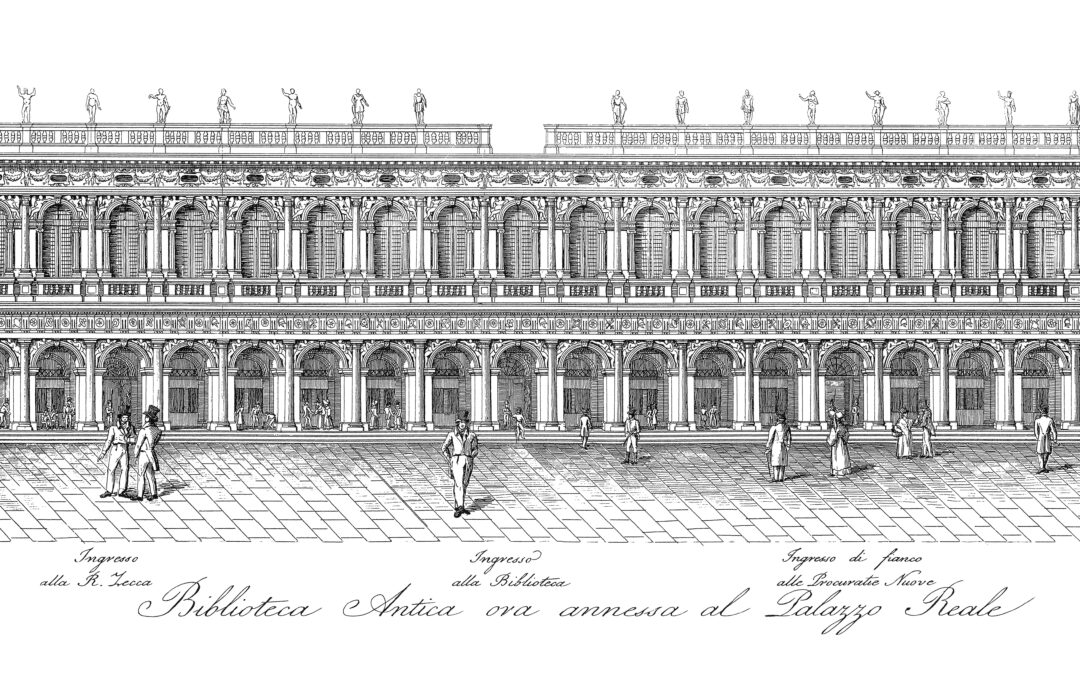
J. Sansovino, biblioteca marciana. Venecia. dibujo por D. Moretti 1831[archivo scalae archive] [scalae pliego Rafael Moneo online]4th extract | cuarto extracto . [English] [ > Español]Rafael Moneo: All the things I have built have been incorporated into everyday life, they have become instruments or tools to be used. I think it is highly satisfying for an architect to see his works not only in action –which would be the traditional expression of an architect still of the 20th century– but also, to recognise therein that specific condition of architecture which makes instruments of, or use of, such buildings. It is this ‘instrumental’ condition of the buildings, which ultimately justifies the figurative models that those of us who build work with, and which only makes sense when ‘life’ is finally incorporated into that work. The way a building such as the Kursaal in San Sebastian works is very satisfying for me as the architect, because it is intensely gratifying to see it being used so intensely. So much so, that it has become the social space of the city par excellence, used by people for all types of functions. The way I see it, it is a great thing to see buildings being used. Although it might appear paradoxical, architecture is alive only when it is being used. When there is no life within, it becomes something else. This is why it is often so difficult to preserve old houses. It saddens me to see those houses that once belonged to artists, writers or politicians being preserved as foundations. I think it is acceptable to admit that buildings can be...

Rafael Moneo por sí mismo: extracto 03/06 del pliego SCALAE: Sobre la iconografía y el ornamento | On iconography and ornament…
Nexus Housing. Fukuoka, Japón por Rem Koolhaas. foto Kenzo Hsieh [archivo scalae archive] [scalae pliego Rafael Moneo online]3rd extract | tercer extracto . [English] [ > Español]Rafael Moneo: The world we live in today manifests a lot less of the symbolic or iconographic forces than we have hither to been subjected to, or at least that’s how it seems. This is perhaps a trivial thought, but it’s true that the things that are closest and most immediate to us appear to be less defined or precise. We are more able to appreciate nowadays the shapes that characterised a specific style, than were those people that produced and lived with that style, for whom it was often unappreciable. So, for example, when we talk of the 1950s, 1960s and 1970s - to take a simplistic example, that of the past - we can now distinguish particular stylistic nuances that those living at that time were not able to discern. And I say this so as not to fall into the temptation of stating that today’s world is a world without form, a world that has forgone symbolism. In my opinion, there is a lot more iconography around than we might think, but it is easier for us to recognise it in the past than in the present. Ornamentation is a different matter. I believe we can understand ornamentation if we look at the very close relationship that existed between architecture and craftsmanship in the past. Manual fabrication is the thing that enabled the existence of ornamentation. Ornamentation is what happened when other hands played a part in the process of...

Rafael Moneo por sí mismo, extracto 02/06 del pliego scalae: Sobre la construcción y el oficio | On construction and the craft…
(a propósito de) Luigi Pareyson >>> [ver +][archivo scalae archive] [scalae pliego Rafael Moneo online]2nd extract | segundo extracto . [English] [ > Español]Rafael Moneo: Buildings designed by architects like Herzog & De Meuron or Rem Koolhaas, attempt to respond formally to building techniques already being used on site, which might be seen as those that industry and culture proffer nowadays as their most immediate response. More often than not, the task of the architect is to give shape to these various construction techniques that reflect our society and our culture. There’s nothing novel about that. Le Corbusier was undoubtedly the last great example of an architect who thought in this way. If one looks at his work retrospectively, and accepts just how much he owes to the physical ideas of his contemporaries, I believe that one could view his whole career as an effort to invent a language which accepts and incorporates everything that is implied in what he thought was the definitive technique in construction – reinforced concrete. There are moments in the history of architecture when it becomes clear just how tightly architectonic form and methods of construction are interwoven. This relationship is less obvious at other times, but, generally speaking, the architect’s efforts are focussed on giving form to such techniques. Architects rely upon the means of construction as proportioned by culture and, of course, by industry. Glass is, perhaps, the most industrialised material (in today’s meaning of the word ‘industrial’) in use today. This is why architects are now so sensitive to techniques that involve wrapping glass around a structure. The function of the...

Rafael Moneo por sí mismo, extracto 01/06 del pliego scalae: Sobre el propio aprendizaje y las técnicas | On my own apprenticeship and technique…
(a propósito de) Francisco Javier Sáez de Oiza >>> [ver +][archivo scalae archive] [scalae pliego Rafael Moneo online]1st extract | primer extracto . [English] [ > Español]Félix Arranz: This text comprises extracts from a conversation with Félix Arranz regarding Rafael Moneo’s reflections on his academic and professional training, the way he works, what motivates him and his achievements to date (at the end of March 2003). The sounds of the conversation are the voice of the architect of Navarre, and in the background, the footsteps on the parquet of those that work in his studio. Nothing else can be heard. The city of Madrid has faded into a comfortable silence. Rafael Moneo:I don’t believe the training we had in my day at the School of Architecture placed much emphasis on technique. Nor do I believe that what was taught in the School, whilst I was studying there, has penetrated into my work. I have fond memories of the subjects we had to study at University. In the Faculty of Exact Sciences we had an exceptional lecturer for the History of Architecture, Leopoldo Torres Balbás. But the time I spent with Francisco Javier Sáenz de Oíza was what really taught me how to be an architect, as well as the many things related to the everyday work of the architect, such as judging/evaluating scale and measurements, drawing, or learning how to place one type of material next to another when one is trying to envisage a detail or a colour. I suppose one must always view architecture as something that is never too far from reality. But the thing I value...

